

Anycast CDN
Classic pull caching for images, scripts, styles and downloads. Point a zone at your origin: we cache at the edge and answer with a 96%+ average hit rate, so your origin serves each file roughly once per TTL per region instead of once per user.
From $5/TB down to $2.50/TB at volume · 14-day testing period on real traffic · $25 monthly minimum waived · Engineer reply within 3 business hours





Small files by default. Large ones too, up to 50 GB.
Under 1 MB
- WebP and AVIF images
- JS bundles and chunks
- CSS and WOFF2 fonts
- JSON and API responses
- SVG icons and sprite sheets
- Map tiles
- Subtitles and VTT files
1 to 10 MB
- Full-size product and article photos
- Short MP4 or WebM loops
- MP3 and AAC audio, voice notes
- PDF price lists and manuals
- ZIP, APK and patch files
- Game textures and sound banks
- ONNX, TFLite and WASM modules
10 MB to 50 GB
- Installers, disk images, asset packs and large archives, up to 50 GB per file
- Same pull cache, same progressive tiers, no separate plan and no size surcharge
- Pick Video CDN instead when files must live inside the CDN and your origin should not have to stay online
Six businesses, the same pull cache
E-commerce and marketplaces
SaaS and web apps
Media and publishing
Software and game distribution
AdTech and MarTech
Education, docs and IoT
Twelve kinds of file, ordered by how much of the web they are
Most of the traffic
- Images: JPEG, PNG, WebP, AVIF, SVG. The heaviest thing the web ships.
- JavaScript bundles, chunks and polyfills.
- CSS and web fonts in WOFF2.
- JSON, API responses, localisation and config files.
Common, growing fast
- Short MP4 and WebM loops, the format that replaced the GIF.
- Audio: MP3 and AAC previews, notification sounds, voice messages.
- PDFs: invoices, manuals, price lists, catalogues.
- User uploads: avatars, listing photos, chat attachments.
Specialised, still static
- Archives and installers: ZIP, APK, patches, disk images, up to 50 GB per file.
- Game assets: textures, atlases, sound banks, level packs.
- Browser ML models and WASM modules: ONNX, TFLite.
- Map tiles, ad creatives with VAST, IoT firmware updates.
Plain files, cached at the edge

 Served from
One file, one URL
Small or large, same cache
Try it with curl
https://cdn84906683.blazingcdn.net/ny-street/mp4/360p.mp4 … https://cdn84906683.blazingcdn.net/ny-street/mp4/2160p.mp4 · Footage: Pexels, free licence Release day, measured
On a software-distribution launch the cache fills as the first requests arrive in each region, then the edge answers the rest. Parallel range-request fill means a large installer is cached in pieces, so a resumed download does not go back to your origin.
Once the edge hit ratio passes 95%, download availability stops depending on origin capacity: your server sees roughly one request per file per region, not one per user.
Figures come from our own edge measurements, not from a vendor benchmark. Ask us for the raw numbers behind your workload. Latency benchmarks →

What's in the box

Cache control

Content protection
Spike resilience

Modern transport

API & automation
Multi-CDN ready
Pull caching, explained in one pass
Reliability is a mechanism, not a number
An edge node goes down
Your origin is unreachable
Ten thousand people hit a cold file at once
You want us as a second CDN
Test CDN Speed Across Top Regions
Avg. Download Speed
Latency
Test link
					{
  "pull_zone": {
    "name": "string",
    "source": "origin",
    "origin": "string",
    "origin_ssl": true,
    "origin_url": "string",
    "bucket_id": "8f7ac8aa-ed2b-4e16-81e0-0766bdb092b8",
    "folder_name": "string",
    "cache_gzipped": true,
    "domain": "string"
  }
}
Powerful API & DevOps Integration
BlazingCDN plugs into the stack you already run: a REST API for zones, cache, certificates and metrics, an official MCP server for AI agents, and a Prometheus endpoint for Grafana or Alertmanager.
Purge and warm up cache from your CI, pull traffic data into your own dashboards, and keep the panel for the rare manual change.
Reliable Network Carriers You Can Trust
- North America
- NTT
- AT&T
- Lumen (Level 3)
- Cogent
- Comcast
- Europe
- NTT
- Deutsche Telekom
- Orange
- Lumen (Level 3)
- Liberty Global
- Sparkle
- Cogent
- Telefónica
- Telia
- Zayo
- Asia-Pacific
- NTT
- Lumen (Level 3)
- KINX
- PLDT
- Singtel
- SK Broadband
- Tata Communications
- Telstra
- South America
- NTT
- Lumen (Level 3)
- Lanautilus
- Telefónica

Anycast CDN

Video CDN | VOD

HLS Streaming CDN
Simple math
$5/TB down to $2.50/TB as volume grows. 100 TB/month ≈ $415. One rate across regions, HTTPS included, no request fees.
Full pricing → · Delivering large files? Compare with Video CDN →
Questions buyers ask about the BlazingCDN Anycast CDN
The BlazingCDN Anycast CDN is a pull-caching CDN for images, scripts, styles, downloads and files up to 50 GB. A zone points at your origin, and the edge answers with a 96%+ average cache hit ratio. Pricing starts at $5 per TB and falls to $2.50 per TB at volume, with no request fees and one rate worldwide.
What does an Anycast CDN cost for 50 TB of static assets?
The BlazingCDN Anycast CDN costs $215 for 50 TB of static assets a month (as of October 2026). The bill follows progressive tiers: the first 5 TB at $5 per TB, the next 20 TB at $4.50, and the remaining 25 TB at $4.00.
The rate is the same in the US, Europe and Asia, and HTTPS is included. BlazingCDN charges no request fees, which matters for small files: a site serving millions of icons, fonts and JSON files pays only for terabytes delivered. No size surcharge applies either, so a 2 GB installer bills on the same tiers as a 20 KB image. For example, doubling traffic to 100 TB raises the bill to $415 in total, and 200 TB costs $765. The monthly minimum is $25 with no long-term contract. Enterprise terms start from 100 TB a month.
How does BlazingCDN pull caching work with my origin?
BlazingCDN pull caching fetches a file from your origin on the first request in a region, stores the file on NVMe SSD edge servers, and serves every later request from that copy until the TTL expires. With a 96%+ average cache hit ratio, the origin serves each file roughly once per TTL per region instead of once per user.
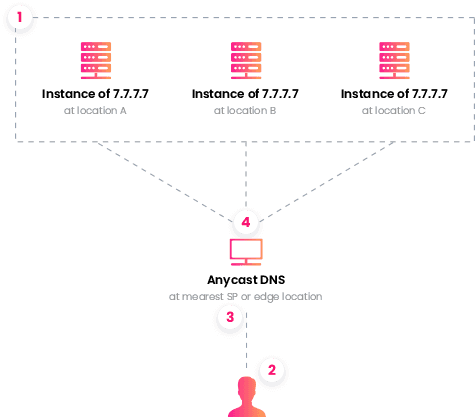
Anycast routing sends each user to a nearby edge through one global IP per zone. If an edge node goes down, Anycast failover moves traffic to the next node without a DNS change. An origin shield can sit between the edge and your server, so repeated misses from many regions do not all reach the origin. For example, when a new file goes live, your server sees roughly one request per file per region, not one per user. Purge clears a path when content changes, and cache rules set TTLs per path.
Can the Anycast CDN deliver files as large as 50 GB?
Yes, the BlazingCDN Anycast CDN delivers files up to 50 GB each, through the same pull cache and on the same progressive tiers as small files. No separate plan and no size surcharge apply.
Large installers, disk images, asset packs and archives are cached with parallel range-request fill. The edge stores a big file in pieces as the first requests arrive, so a resumed download does not go back to the origin. Once the edge hit ratio passes 95%, download availability stops depending on origin capacity. Measured June 2026 on a 100 MB HTTPS download, the network delivered 1.12 Gb/s in Europe, 1.11 Gb/s in North America and 761 Mb/s in Asia. For example, a 2 GB game patch pulled 50,000 times is 100 TB of traffic, which costs $415 a month (as of October 2026). Choose Video CDN instead when files must live inside the CDN without an origin online.
What can't the BlazingCDN Anycast CDN do?
The BlazingCDN Anycast CDN caches and delivers static files. The network does not run code at the edge, hold WebSocket connections, serve HTTP/3 or transcode video, and buyers should plan around those four gaps.
The Anycast CDN also expects an origin that stays online and answers cache misses. When content must live inside the CDN, Video CDN with permanent cache fits better: the first 500 GB are included, then storage costs $0.02 per GB per month (as of October 2026). Cloud Storage is another origin option at $0.015 per GB per month. Personalized pages, shopping carts and live chat stay with your application servers. What the Anycast CDN does cover: HTTP/2, IPv6, TLS 1.3, gzip, Brotli and zstd compression, origin shield, signed URLs, purge and real-time statistics. For example, an online store can cache product photos and scripts while checkout stays on the origin.
How do I move static assets to the Anycast CDN safely?
BlazingCDN moves static assets in about one hour of onboarding with an engineer, then a 14-day testing period on real production traffic. Nothing has to be switched all at once.
The steps are short. First, create a pull zone that points at your current origin or bucket. Second, test the zone on its temporary hostname with curl or a browser. Third, add your own hostname and SSL certificate. Then shift traffic gradually: BlazingCDN can run as a second CDN behind DNS with a weighted split, so for example 20% of users reach BlazingCDN while the current provider serves the rest. Real-time statistics and Prometheus metrics show cache hit ratio and traffic during the comparison. A KYC check is required before production traffic. If the numbers disappoint, the DNS weight returns to the old CDN. The $25 monthly minimum (as of October 2026) is waived during the testing period.